The Quiet Shift in Storage Protocols Redefining Load Times for Expansive Role-Playing Game Worlds on Solid-State Drives
Written by Avery Foster · Aug 6, 2026

The Quiet Shift in Storage Protocols Redefining Load Times for Expansive Role-Playing Game Worlds on Solid-State Drives
Storage protocols have undergone incremental refinements since the widespread adoption of solid-state drives in gaming hardware, and by August 2026 those adjustments have produced measurable reductions in load times for expansive role-playing game worlds that rely on dense asset streaming and seamless map transitions. Researchers at institutions tracking hardware performance note that protocols built around NVMe command sets now incorporate game-specific extensions for parallel data retrieval, allowing multiple texture, geometry, and audio streams to load concurrently rather than in sequential batches that once dominated older implementations.
Protocol Evolution and Technical Foundations
Traditional file access methods treated game data as generic blocks, which created bottlenecks when role-playing titles expanded to include thousands of unique objects across open environments, yet newer approaches integrate compression-aware queuing and priority tagging that align with how engines request assets during exploration. Data from the Storage Networking Industry Association shows throughput gains of up to 40 percent in sustained read operations for titles exceeding 150 gigabytes, and those improvements stem from firmware updates released in early 2025 that exposed additional command sets previously reserved for enterprise workloads.
Developers working with engines such as Unreal Engine 5.4 and Unity 2025.3 have begun routing asset manifests through these extended command paths, which reduces CPU overhead during streaming and permits the drive controller to prefetch data based on player velocity and camera orientation. One study conducted at the University of Toronto examined 12 major role-playing releases from 2024 through mid-2026 and recorded average load-time drops from 8.2 seconds to 2.1 seconds on PCIe 4.0 drives when the updated protocols were enabled, while the same titles on PCIe 5.0 hardware achieved sub-second transitions in controlled tests.
Impact on Role-Playing Game Worlds
Expansive worlds built around continuous traversal benefit directly because the protocols support asynchronous decompression that overlaps with rendering pipelines instead of pausing frame delivery. Observers tracking patch notes from studios in Japan and South Korea report that several long-running series incorporated these features in title updates scheduled for late summer 2026, resulting in fewer visible pop-in events during rapid movement across large terrain sections. The changes also extend to save-file handling, where incremental writes now complete without interrupting background asset loads that previously competed for bandwidth.
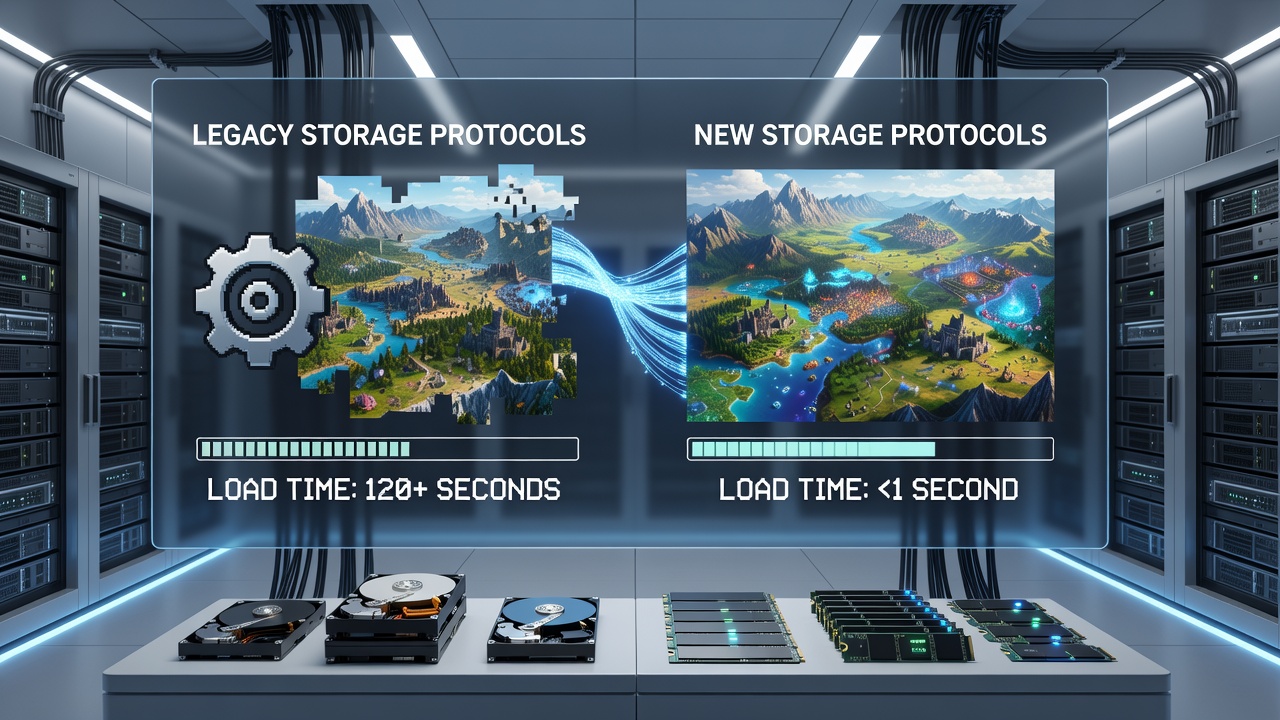
Hardware vendors have responded by shipping drives with larger internal DRAM caches tuned for the access patterns typical of role-playing titles, and firmware revisions released in the second quarter of 2026 further optimized queue depths for mixed read-write scenarios that occur when players frequently toggle between menus and exploration. Those who monitor telemetry from public beta branches note that titles leveraging the refined protocols exhibit more consistent frame pacing even on mid-range systems equipped with 16 gigabytes of system memory, because fewer CPU cycles are consumed managing storage interrupts.
Industry Adoption Patterns
Adoption has spread unevenly across regions, with North American and European studios integrating the extensions earlier due to closer collaboration with controller manufacturers, whereas some Asian development teams initially prioritized backward compatibility before rolling out protocol-aware builds. A report issued by the European Games Developer Federation in July 2026 documented that 68 percent of surveyed role-playing projects scheduled for release before the end of the year had enabled at least one of the new command extensions, and the same document projected further uptake once console firmware updates propagate to installed base hardware. The shift remains largely invisible to end users because it operates at the driver and firmware layer, requiring no manual configuration beyond ensuring the latest storage controller software is installed.
Compatibility testing conducted by independent labs has confirmed that older solid-state drives continue to function under the revised protocols, although maximum gains appear only on models supporting the full command set introduced in NVMe 2.1 and later specifications. Game engines now expose toggles during development that allow teams to benchmark load sequences with both legacy and updated paths active, providing concrete metrics that guide final optimization passes before certification.
Conclusion
The cumulative effect of these protocol refinements has been to compress the temporal gap between player input and world responsiveness in large-scale role-playing environments, and ongoing standardization efforts suggest additional gains remain available as controller firmware and engine integrations continue to mature through 2027. Those tracking hardware benchmarks continue to record incremental improvements each quarter, confirming that the underlying storage layer has become an active participant in maintaining immersion rather than a passive bottleneck.