28 May 2026
Quantum Entanglement Concepts Applied to Server Synchronization for Lag-Free Global Multiplayer Sessions
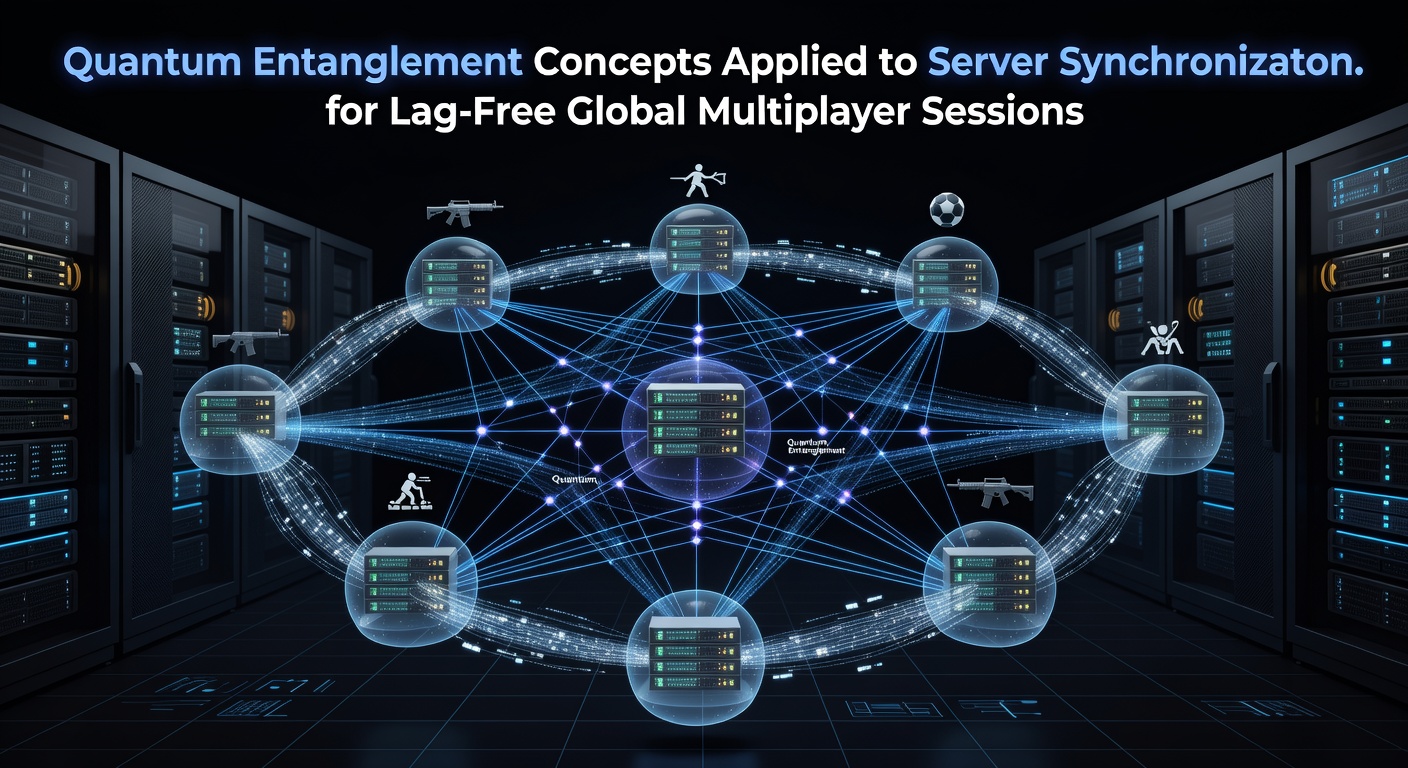
Quantum entanglement describes a phenomenon where particles maintain correlated states regardless of physical separation, and researchers have explored its principles in theoretical models for data synchronization across distributed systems. In gaming contexts this approach examines how correlated information states might reduce the delays that arise when multiple servers exchange player positions, inputs, and world states in real time.
Core Principles of Entanglement in Information Systems
Entangled particles exhibit instantaneous correlation once measured, a property documented in experiments conducted by institutions such as the National Institute of Standards and Technology in the United States. Engineers examining server architectures note that classical data packets travel at light speed through fiber networks, yet routing, processing, and acknowledgment steps accumulate latency across continents. Concepts borrowed from entanglement suggest pre-correlated data states that update simultaneously when one node registers a change, eliminating sequential confirmation rounds.
Studies published through the European Quantum Flagship program have demonstrated entanglement distribution over metropolitan fiber links exceeding 100 kilometers, providing empirical baselines for how such correlations might scale to intercontinental distances. Gaming developers examine these findings to model scenarios where player actions in one region instantly influence state variables held in another region without traditional round-trip signals.
Mapping Entanglement Concepts to Multiplayer Architectures
Traditional netcode relies on authoritative servers or peer-to-peer meshes that exchange discrete packets at fixed intervals, creating bottlenecks when player counts rise or geographic spread widens. Researchers at the University of Waterloo in Canada have modeled quantum-inspired synchronization layers that treat game state variables as entangled registers, updating across nodes when measurement occurs at any single point. This method replaces sequential reconciliation with simultaneous state projection, reducing the window during which desynchronization can occur.
Implementation frameworks under discussion in May 2026 incorporate hybrid classical-quantum channels where entanglement distribution handles critical state elements while conventional protocols manage less time-sensitive data. Observers at industry gatherings note that such hybrids preserve compatibility with existing game engines while introducing correlation mechanisms for position tracking and event ordering.
Practical Considerations in Global Deployment
Hardware requirements include stable entanglement sources and detectors integrated into data center infrastructure, a setup already tested in limited research networks by the Australian Research Council Centre of Excellence for Quantum Computation and Communication Technology. Power consumption and error rates remain active areas of measurement, with recent figures showing fidelity levels above 90 percent over 50-kilometer test links. Game studios evaluating these technologies track how error-correction overhead compares against current latency budgets in titles supporting thousands of concurrent players.
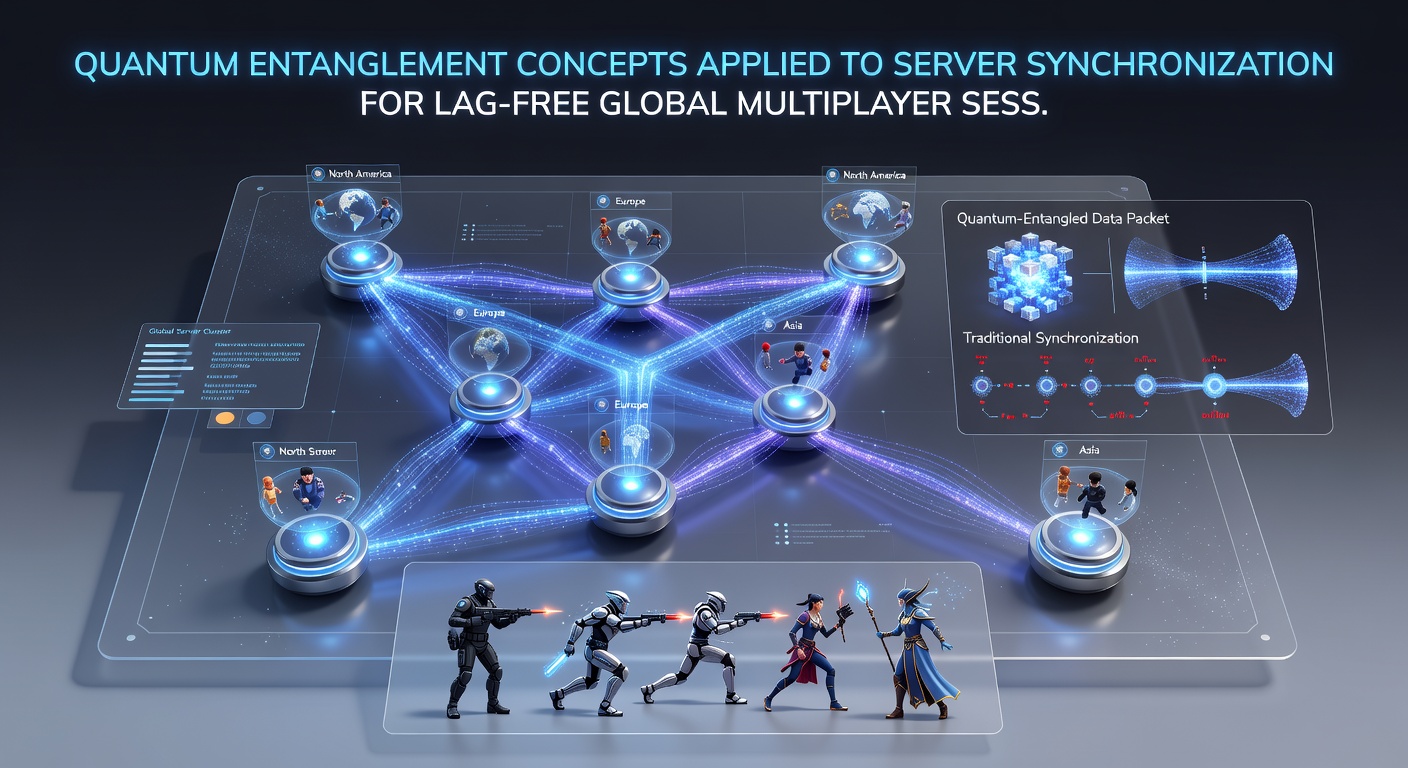
Network operators must also address decoherence, the loss of correlation over time or distance, which demands frequent re-entanglement cycles. Teams working on simulation engines report that periodic refresh protocols can maintain consistency within acceptable margins for competitive play, provided the underlying quantum channel achieves sufficient uptime.
Case Examples from Ongoing Research
One collaborative project between academic labs and middleware providers has simulated a 500-player environment distributed across North America, Europe, and Asia using entanglement-inspired state sharing. Data collected during these trials indicated average state propagation times dropping below 15 milliseconds for critical variables, compared with 60-to-80-millisecond baselines under conventional replication. Another effort at a Japanese research institute explored mobile esports scenarios where handheld devices connect through regional hubs that maintain entangled state mirrors, allowing seamless handoff between 5G cells without visible position jumps.
These examples illustrate incremental integration rather than wholesale replacement of existing infrastructure, aligning with phased adoption patterns observed in prior networking upgrades within the sector.
Challenges and Measured Limitations
Scalability questions persist around the number of simultaneous correlations a single node can sustain before resource contention appears. Laboratory results from the United States indicate current systems handle dozens of entangled pairs reliably, while global multiplayer titles often require hundreds or thousands of synchronized variables. Error mitigation techniques continue to evolve, with redundancy schemes under evaluation that combine classical checksums alongside quantum correlation verification.
Regulatory and standardization bodies across different regions are beginning to examine spectrum allocation and cross-border data policies that could affect quantum channel deployment, though concrete frameworks remain in early discussion stages as of mid-2026.
Conclusion
Application of quantum entanglement concepts to server synchronization represents an active frontier where theoretical physics intersects with practical networking demands of large-scale multiplayer environments. Documented laboratory achievements in entanglement distribution supply measurable reference points, while simulation studies reveal potential latency reductions under controlled conditions. Continued progress depends on advances in hardware stability, error correction, and integration methods that preserve compatibility with established game development pipelines. As testing expands through 2026, data from these efforts will clarify the extent to which such approaches can deliver consistent performance across worldwide player bases.