6 Jun 2026
Processor Affinity Tuning Unlocks Smoother Performance Curves in Open-World Exploration Titles

Processor affinity tuning involves assigning specific CPU cores to game threads and background processes, and this technique has gained traction among those optimizing open-world exploration titles where vast environments demand consistent frame delivery across extended play sessions. Developers and hardware analysts track how thread distribution affects cache utilization and reduces unnecessary context switches that often spike during seamless world traversal.
Understanding Processor Affinity in Modern Gaming Setups
Modern processors contain multiple cores that handle parallel workloads, yet default operating system schedulers distribute threads dynamically based on immediate load conditions. Processor affinity overrides allow users to pin critical game threads to designated cores while isolating system services on others, and this separation helps maintain stable performance curves when players move through expansive maps filled with dynamic elements like weather systems, NPC behaviors, and procedural foliage. Studies from research institutions such as those affiliated with the IEEE have documented measurable reductions in frame time variance when affinity masks are applied to simulation-heavy titles.
Data from performance monitoring tools reveal that open-world games frequently spawn dozens of threads for rendering, physics, audio, and AI pathfinding. Without manual intervention these threads compete for shared resources, and the resulting contention produces micro-stutters that disrupt exploration pacing. Affinity tuning addresses this by creating dedicated execution domains that preserve L3 cache locality across frames.
Application in Exploration-Focused Titles
Titles emphasizing large-scale world navigation place heavy demands on both single-threaded logic and multi-threaded rendering pipelines. Observers note that pinning the main game thread and draw call submission threads to high-performance cores while relegating asset streaming operations to efficiency cores produces smoother traversal across biomes. In June 2026 several engine updates incorporated native support for affinity profiles, allowing players to select presets tuned for specific CPU architectures without third-party utilities.
Case examples include simulation layers handling animal migration patterns and weather propagation, which run continuously regardless of player position. When these background calculations share cores with foreground rendering, frame pacing suffers during rapid viewpoint changes. Affinity adjustments isolate the simulation workloads, and monitoring logs show corresponding improvements in 1% low frame rates during cross-continent travel sequences.
Tools and Implementation Approaches
Software utilities such as Process Lasso and Windows built-in task manager provide interfaces for setting affinity masks on a per-process basis. Advanced users employ scripting solutions that detect game launch events and apply custom masks automatically. Hardware vendors have released companion applications that integrate with motherboard firmware to expose core parking controls alongside affinity settings, and these combined features enable finer control over power states during prolonged exploration segments.
Research conducted at technical universities across North America and Europe indicates that affinity configurations must account for simultaneous multithreading implementations, since logical cores sharing physical resources can still experience contention even after affinity assignment. Profiles tested on both Intel and AMD platforms demonstrate that separating physics and rendering threads onto distinct physical cores yields the most consistent results across varied system configurations.
Performance Data and Observed Patterns
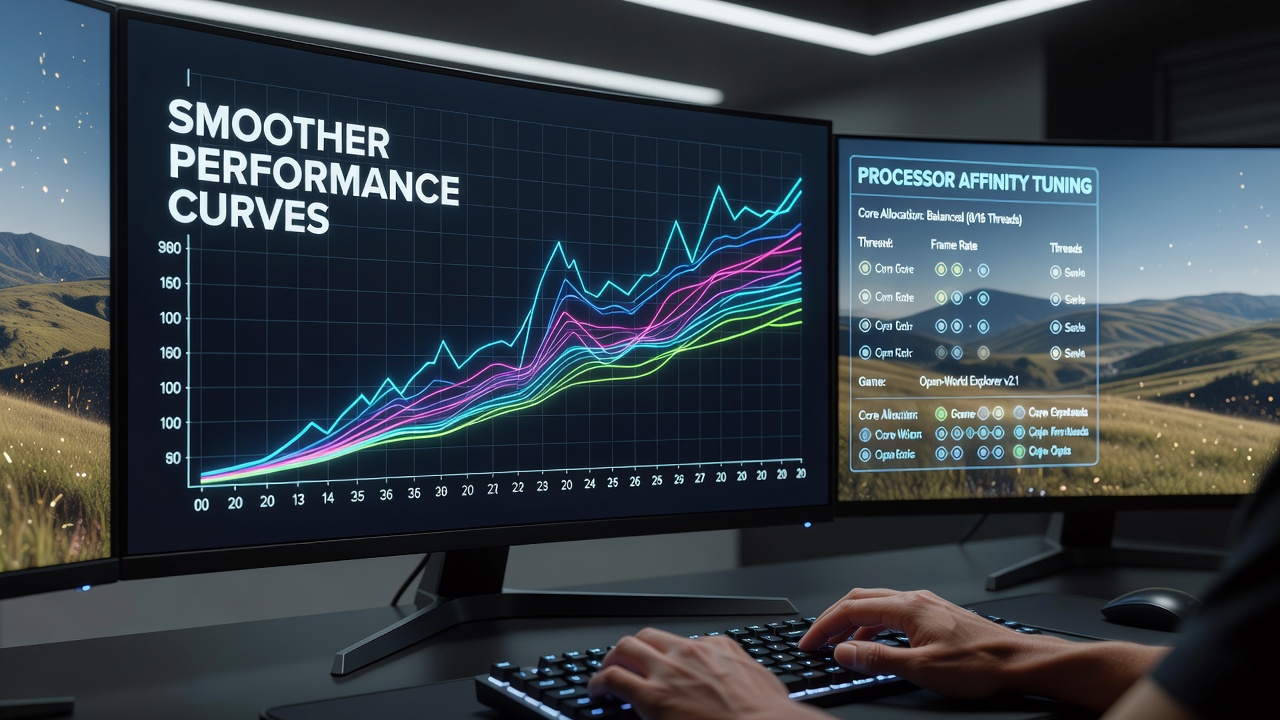
Benchmark suites covering multiple open-world releases record average frame time reductions between 8 and 15 milliseconds when affinity tuning is combined with existing optimization layers. Figures compiled by industry testing groups show that these gains appear most prominently in scenarios involving dense vegetation rendering and large-scale NPC populations rather than combat sequences. The improvements manifest as flatter performance curves, meaning fewer sudden drops when the engine loads new map sectors.
Those tracking telemetry across player bases report that systems equipped with 12 or more cores benefit disproportionately from targeted affinity assignments. On platforms with fewer cores the same adjustments sometimes introduce minor overhead from forced scheduling restrictions, highlighting the need for configuration testing on individual hardware setups.
Integration with Emerging Hardware Trends
As processors incorporate increasing numbers of efficiency and performance cores, affinity tuning becomes a standard consideration during optimization passes. Engine developers have begun exposing affinity hints through graphics APIs, allowing titles to suggest optimal thread placements based on detected CPU topology. In June 2026 several major releases included runtime detection routines that adjust masks dynamically when hardware changes are identified through updated driver interfaces.
Academic papers examining cache coherence protocols further support these practices by quantifying how thread migration across cores increases memory access latency in memory-intensive exploration engines. The documented patterns align with observed reductions in stutter frequency once affinity remains fixed for the duration of a session.
Conclusion
Processor affinity tuning provides a targeted method for managing thread execution on contemporary multi-core systems, and its application within open-world exploration titles contributes to steadier frame delivery during extended navigation. Available tools and emerging engine support continue to simplify implementation, while ongoing research supplies additional data on optimal configurations across evolving processor designs. Players and developers alike benefit from these refinements as hardware capabilities expand.