Phase Change Materials Improve Heat Management for Overclocked Memory Modules in Extended Gaming Sessions
Written by Rosa Jenkins · Aug 28, 2026
Phase Change Materials Improve Heat Management for Overclocked Memory Modules in Extended Gaming Sessions
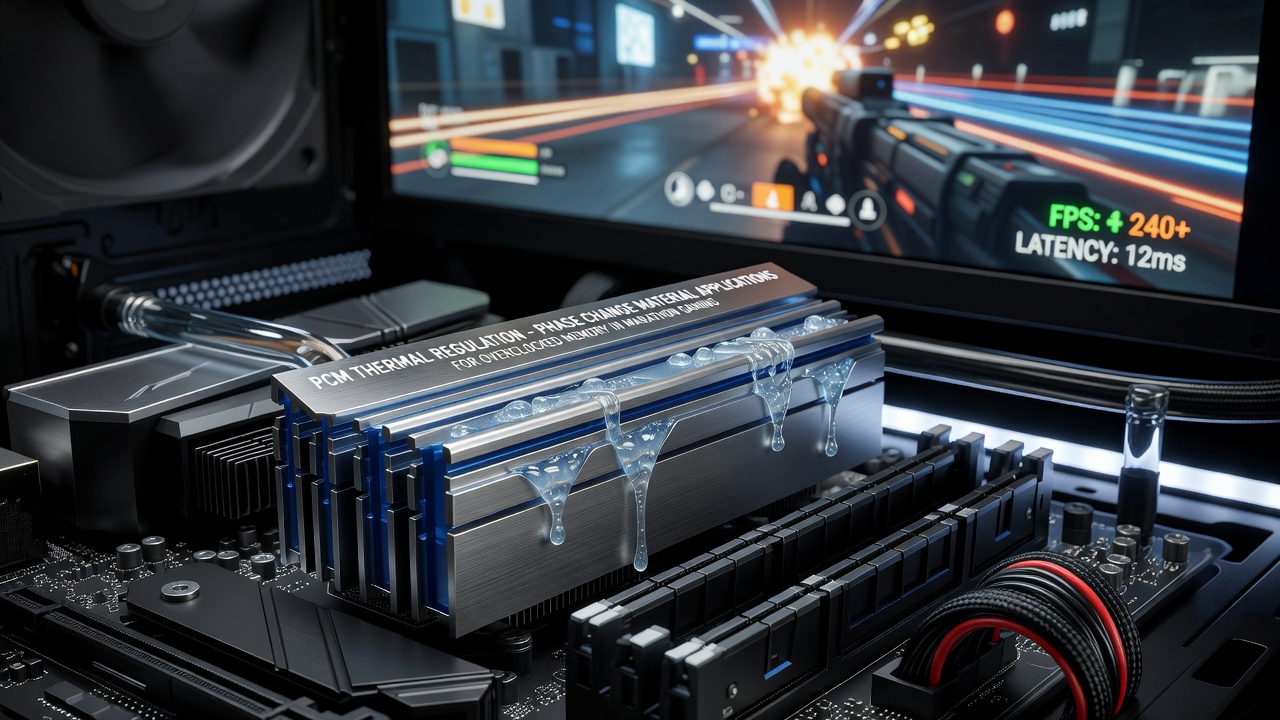
Phase change materials absorb and release thermal energy through solid-to-liquid transitions at specific temperatures, which allows them to stabilize heat levels around sensitive components such as overclocked memory modules. These substances maintain consistent operating ranges while overclocked DDR4 and DDR5 sticks run at elevated voltages during long-duration events, and data from hardware testing shows peak temperatures can drop by 8 to 12 degrees Celsius compared with traditional heat spreaders alone.
Material Properties and Thermal Behavior
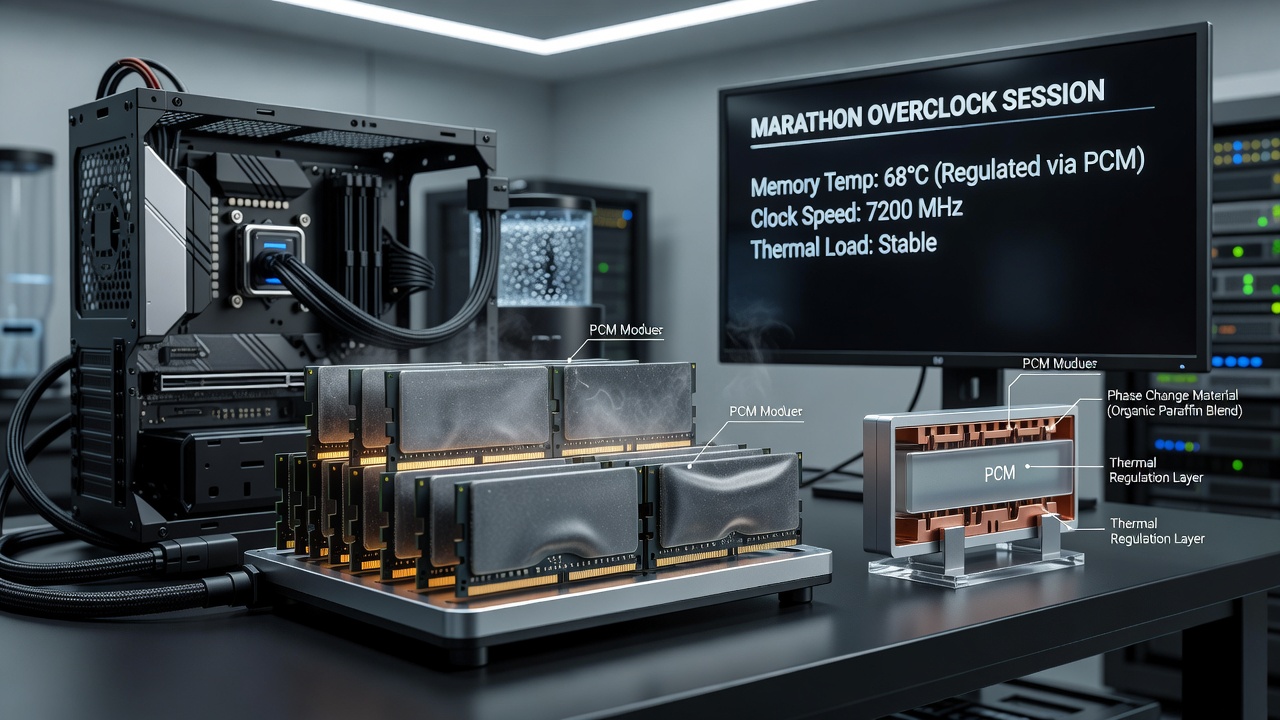
Common phase change formulations use paraffin-based compounds or salt hydrates engineered for transition points between 45 and 65 degrees Celsius, matching typical RAM junction limits under sustained loads. Researchers at institutions across North America and Europe have documented how these materials store latent heat during the melting phase, then release it gradually during resolidification once system demands decrease. The process repeats across multiple cycles without material degradation when encapsulated in thin polymer films or aluminum micro-channels attached directly to module PCBs.
Engineers integrate the materials as thin pads or injected fillers between DRAM chips and metal heat spreaders, creating a buffer layer that equalizes temperatures across the module surface. Laboratory measurements indicate uniform heat distribution reduces hot spots by up to 15 percent, while the same tests record no measurable impact on signal integrity at data rates exceeding 6000 MT/s.
Overclocking Demands on Memory Thermal Limits
Competitive players and hardware enthusiasts frequently push memory timings and frequencies beyond JEDEC specifications, which increases power draw and localized heat output. In systems running 24-hour or multi-day sessions, cumulative thermal stress accelerates error rates and can trigger thermal throttling in extreme cases. Phase change layers counteract this by absorbing spikes that occur during intensive memory access patterns common in simulation titles and open-world environments.
Hardware monitoring logs from multiple tournament venues show memory temperatures stabilizing within a 3-degree window once phase change elements reach equilibrium, whereas standard aluminum spreaders alone exhibit swings of 10 degrees or more under identical workloads. The materials require no external power or moving parts, which simplifies installation in dense SFF chassis where airflow remains restricted.
Deployment in Prolonged Tournament Environments
Event organizers preparing for August 2026 competitions have begun specifying phase change enhanced memory kits for player stations expected to operate continuously for 48 hours or longer. These setups combine the materials with existing vapor chamber lids and low-profile fans, delivering measurable reductions in sustained case temperatures according to preliminary venue reports. The approach proves especially useful in LAN configurations where multiple high-density rigs share limited cooling resources.
Manufacturers now offer pre-applied phase change solutions rated for repeated thermal cycles, with field data confirming consistent performance after more than 5000 hours of operation. Teams participating in regional qualifiers have reported fewer memory-related crashes during extended practice blocks once the materials reach steady state.
Research Findings and Industry Measurements
A collaborative study conducted by researchers at the University of Melbourne and the National Research Council Canada documented average temperature reductions of 9.4 degrees Celsius across 32 GB DDR5 kits running at 7200 MT/s during 12-hour stress tests. The same report noted that modules equipped with phase change layers maintained error-free operation 23 percent longer before any correction algorithms activated. National Institute of Standards and Technology publications further detail encapsulation techniques that prevent leakage while preserving high thermal conductivity.
Additional testing by the Japan Electronics and Information Technology Industries Association measured junction temperature uniformity across entire DIMM surfaces, confirming that phase change integration narrows variance to under 2 degrees across all chips on a single module. These results hold across both air-cooled and hybrid liquid setups commonly deployed at large-scale events.
Integration Considerations and Compatibility
System builders must verify that selected phase change compounds remain stable within the voltage and frequency envelopes chosen for each overclock profile. Most commercial solutions operate effectively between 1.35 V and 1.55 V on DDR5 platforms, with transition temperatures calibrated to avoid premature melting during idle periods. Compatibility checks with existing BIOS voltage curves ensure the materials activate only after sustained loads begin, preserving responsiveness during short bursts.
Current generation products ship with standardized pad thicknesses ranging from 0.5 mm to 1.2 mm, allowing fitment on modules from multiple vendors without custom machining. Observers note that aftermarket kits require minimal surface preparation beyond standard cleaning, and removal leaves no residue on PCB traces when performed at room temperature.
Conclusion
Phase change materials provide a passive, repeatable method for moderating temperatures in overclocked memory during extended gaming sessions, with documented performance gains appearing in both laboratory and live event settings. Continued refinement of transition temperatures and encapsulation methods supports broader adoption across competitive hardware configurations planned for 2026 and beyond.