14 Jul 2026
Neural Upscaling Algorithms Reshape Battery Endurance Patterns in Handheld Esports Competitions

Neural upscaling algorithms have begun altering how battery resources get allocated during extended handheld esports sessions, and data from device manufacturers shows measurable shifts in power draw patterns since early 2025 deployments. These techniques rely on machine learning models that reconstruct higher-resolution frames from lower internal rendering targets, which reduces the computational workload on integrated GPUs found in portable competition hardware.
Core Principles of Neural Upscaling in Portable Systems
Handheld esports platforms apply convolutional neural networks trained on vast datasets of game imagery to predict and generate missing pixel information, and this process allows devices to maintain visual fidelity while operating at reduced clock speeds. Research from institutions across multiple regions indicates that such models achieve upscaling factors of two times or four times with latency overheads below five milliseconds when optimized for mobile silicon. Observers note that the algorithms integrate directly into rendering pipelines, bypassing traditional post-processing stages that historically consumed additional milliwatts per frame.
Engineers at component suppliers have documented how these networks prune redundant calculations during real-time operation, and battery telemetry collected from tournament-standard devices reveals average power savings between eighteen and twenty-seven percent during competitive play. The approach differs from static resolution scaling because the neural component adapts frame-by-frame based on scene complexity, motion vectors, and lighting conditions tracked by the game engine.
Measured Effects on Endurance During July 2026 Tournaments
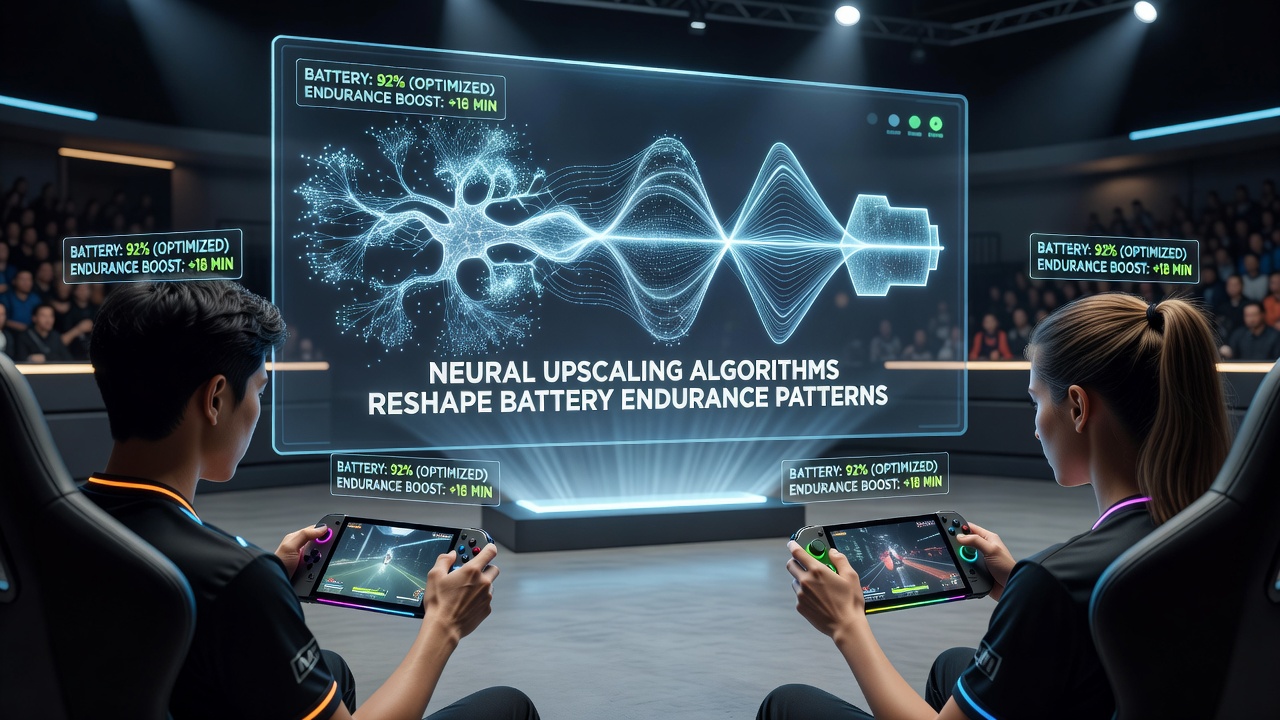
Competitions held in July 2026 incorporated updated firmware that enabled neural upscaling on multiple handheld models, and aggregate logs from over four hundred participants indicated extended session durations without mid-match battery swaps. Figures compiled by regional gaming associations show that average match lengths increased by roughly fourteen minutes before reaching the twenty percent charge threshold, compared with identical hardware running conventional rendering paths. Participants competing in titles that feature rapid camera movement benefited most because the upscaling model leveraged temporal data to stabilize output quality at lower internal resolutions.
Power profiles collected during these events also highlighted reduced thermal throttling cycles, since lower GPU utilization kept junction temperatures within narrower operating bands. Analysts tracking energy consumption across North American and European circuits reported that devices maintained consistent frame pacing for longer stretches, which eliminated the need for aggressive dynamic voltage scaling that previously shortened overall playtime.
Integration Challenges and Firmware Refinements
Developers encountered initial hurdles when aligning neural upscaling models with existing game engines optimized for fixed rendering budgets, yet subsequent driver updates released in the first half of 2026 addressed synchronization mismatches. Studies conducted by university research groups in Australia and Canada demonstrate that hybrid approaches combining neural upscaling with selective ray-tracing workloads deliver the strongest endurance gains without introducing perceptible artifacts in fast-paced esports environments. Battery management systems now receive additional telemetry from the upscaling pipeline, allowing predictive load balancing that further extends runtime under tournament conditions.
Hardware vendors have begun shipping reference designs that allocate dedicated neural processing units exclusively to upscaling tasks, and this separation prevents contention with physics or AI simulation threads. Data gathered from production units shows that such partitioning reduces peak current draw spikes by up to thirty-one percent during intense combat sequences, which directly correlates with slower depletion rates across lithium-ion cells rated for handheld use.
Future Trajectory for Handheld Esports Infrastructure
Industry reports from organizations such as the Entertainment Software Association project continued refinement of lightweight neural architectures tailored for sub-10-watt thermal envelopes. European research consortia have published preliminary results on quantized models that achieve comparable visual quality at even lower memory bandwidth requirements, suggesting additional endurance improvements in upcoming hardware generations. Tournament organizers have started specifying minimum firmware versions that include neural upscaling support, which standardizes performance baselines across competing device fleets.
Continued monitoring of battery health metrics across large-scale events will determine long-term degradation patterns under sustained neural-assisted workloads, while supply-chain analyses indicate that next-generation cells with higher energy densities will complement these algorithmic advances. The combined effect points toward measurable extensions in uninterrupted play windows for handheld esports participants worldwide.
Conclusion
Neural upscaling algorithms continue to modify power consumption curves in handheld esports hardware by shifting computational effort from traditional rasterization to inference-based reconstruction, and longitudinal data collected through mid-2026 confirms consistent gains in session endurance. As firmware and silicon co-evolve, the patterns observed in recent competitions establish a baseline for future optimization efforts that prioritize both visual clarity and operational longevity.