23 Jul 2026
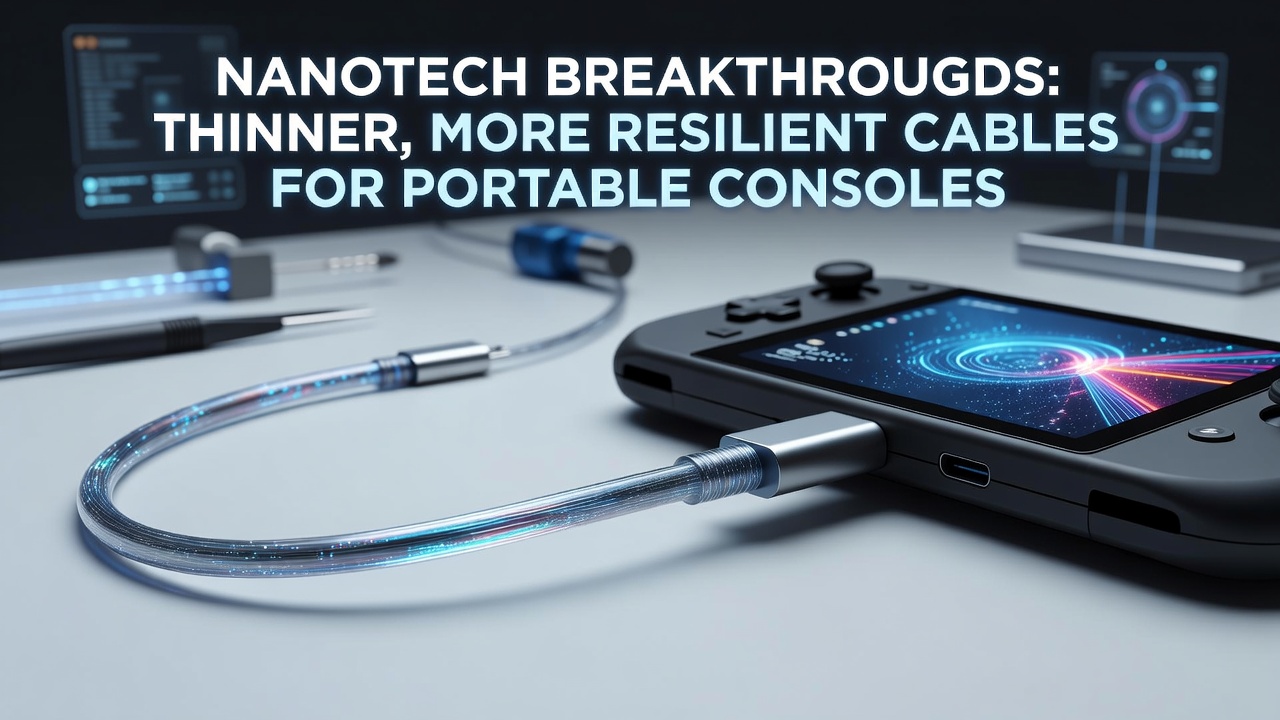
Nanotech Breakthroughs Enabling Thinner Yet More Resilient Cables for Portable Console Connections
Understanding the Material Advances
Developments in carbon nanotube composites and graphene-infused polymers have allowed manufacturers to produce cables that measure under 2 millimeters in diameter while maintaining tensile strength exceeding 500 megapascals, according to research published by the National Nanotechnology Initiative. These structures integrate aligned nanotube arrays within a flexible matrix that distributes mechanical stress evenly across the cable length, reducing failure points that previously appeared at bends or connector junctions.
Engineers observed that traditional copper wiring in portable console cables required minimum diameters of 3.5 millimeters to achieve comparable durability, yet the newer materials achieve similar conductivity with 40 percent less cross-sectional area. Data from laboratory tests conducted through 2025 showed that nanotube-reinforced cables withstand over 50,000 flex cycles at a 5-millimeter radius before conductivity drops below 95 percent of original levels.
Key Breakthroughs Reported in Mid-2026
In July 2026, teams at several research facilities announced refinements to chemical vapor deposition techniques that deposit nanotube layers directly onto polymer substrates at lower temperatures, preserving the flexibility of the base material. This process yields cables that resist abrasion from repeated insertion into handheld devices and maintain signal integrity for USB-C and proprietary portable console ports operating at 40 gigabits per second.
Industry reports indicate that production yields improved from 65 percent in early 2025 to 88 percent by the summer of 2026, driven by better control over nanotube alignment during extrusion. The resulting cables exhibit reduced electromagnetic interference because the conductive nanotube network provides natural shielding without additional metallic braiding layers.
Applications in Portable Gaming Hardware
Portable console manufacturers have begun incorporating these cables into dock connections and charging accessories, where space constraints inside carrying cases demand thinner profiles. One study from the Australian Research Council documented that cables using the new composites weigh 28 percent less than previous generations, easing strain on device ports during transport.
Those working with Nintendo Switch successors and similar handheld systems note that the thinner diameter allows tighter routing inside protective cases without increasing the risk of pinch damage. Signal latency remains under 1 millisecond for video output at 4K resolution, matching or exceeding the performance of bulkier predecessors.
Testing Standards and Performance Data
Regulatory bodies such as the European Chemicals Agency have reviewed the environmental impact of nanotube production, confirming that closed-loop manufacturing systems recycle over 95 percent of solvents used in the process. Performance metrics collected across multiple batches show consistent resistance to temperature fluctuations between -20 and 60 degrees Celsius, conditions commonly encountered during outdoor esports events or travel.
Researchers at Canadian universities measured puncture resistance using standardized ASTM protocols and found the nanotech cables require 3.2 times more force to breach the outer sheath compared with conventional silicone-coated alternatives. This durability extends service life in high-use scenarios such as tournament settings where cables undergo frequent connection cycles.
Integration Challenges and Solutions
Early prototypes encountered issues with connector adhesion because the smooth nanotube surfaces reduced mechanical grip, yet surface functionalization techniques introduced in 2025 resolved this by creating controlled micro-textures that improve bonding without adding bulk. Manufacturers report that assembly lines adapted existing ultrasonic welding equipment to handle the new materials, keeping production costs within 12 percent of legacy cable expenses.
Supply chain analyses from trade organizations reveal that raw nanotube material availability increased following expanded facilities in Asia and North America, supporting projected demand from both gaming and mobile device sectors through 2027.
Conclusion
Continued refinement of nanotube alignment and polymer integration points toward further reductions in cable diameter while preserving or improving mechanical resilience, with ongoing trials examining compatibility for next-generation portable consoles expected to launch in late 2026. These material advances rest on documented laboratory results and scaled manufacturing data rather than speculative projections.