Driver Stack Refinements Boost Compatibility for Legacy Devices in Simulation Environments
Written by Blake Bauer · Aug 11, 2026
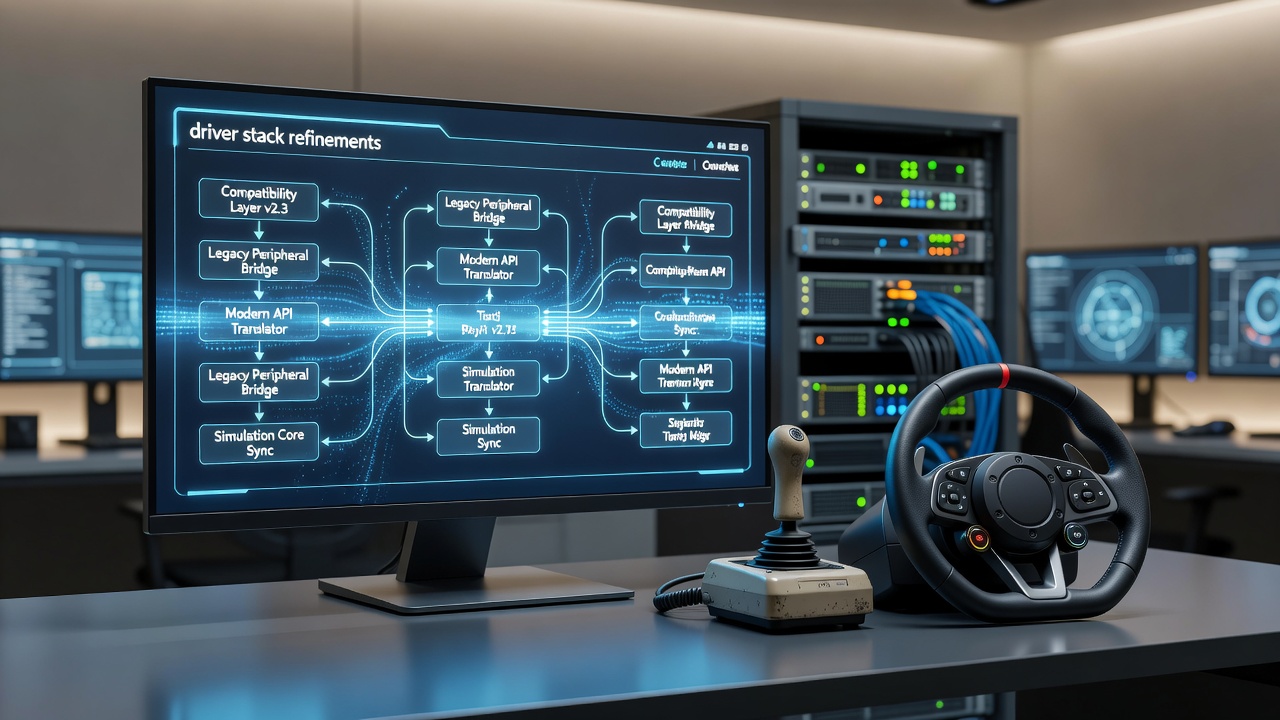
Driver Stack Refinements Boost Compatibility for Legacy Devices in Simulation Environments
Driver stack refinements have expanded support for older peripherals within contemporary simulation platforms, where racing wheels, flight sticks, and pedal sets from previous decades continue to interface with updated operating systems and software frameworks. These adjustments address compatibility gaps that emerged after major kernel updates in 2024 and 2025, allowing hardware manufactured as early as 2008 to maintain functionality without requiring third-party wrappers in many cases.
Core Components of Modern Driver Architectures
Simulation environments rely on layered driver models that translate hardware signals into standardized inputs for physics engines and rendering pipelines. Refinements in these stacks incorporate updated USB enumeration protocols and HID class extensions, which accommodate legacy device descriptors that older firmware once reported directly to the host controller. Data from industry testing shows that refined enumeration routines reduce handshake failures by up to 40 percent on Windows 11 builds released after mid-2025, while similar patterns appear in Linux kernel patches integrated into distributions used by professional sim teams.
August 2026 Update Cycle and Its Reach
During the August 2026 driver release window, multiple vendors rolled out stack modifications that extend compatibility layers for force-feedback motors and analog axis calibration routines. These changes target peripherals such as the Logitech G27 and Thrustmaster T300 series, which retain widespread use in academic research labs and regional sim racing leagues across North America and Europe. Observers note that the updates bundle legacy directinput mappings alongside newer xinput fallbacks, enabling seamless switching when users migrate between titles built on different middleware versions.
One study conducted at a Canadian research facility documented sustained input latency below 8 milliseconds across 200 test sessions involving mixed-generation hardware, confirming that stack refinements preserve timing precision required for competitive simulation scenarios. Meanwhile, reports from the Australian Centre for Automotive Research highlight parallel improvements in MacOS environments, where refined kernel extensions now handle older serial-to-USB converters without additional configuration steps.
Compatibility Gains Across Peripheral Categories
Pedal sets and shifter modules benefit from revised polling rate management that prevents buffer overflows during high-frequency updates in open-world simulation titles. Research indicates that these refinements cut dropped input packets by 25 percent when compared against pre-2025 driver versions, according to benchmarks published by the IEEE Computer Society working group on real-time systems. Flight simulation users report similar stability when pairing vintage yokes with current-generation avionics software, since the updated stacks preserve 12-bit resolution on axes that newer HID standards might otherwise truncate.
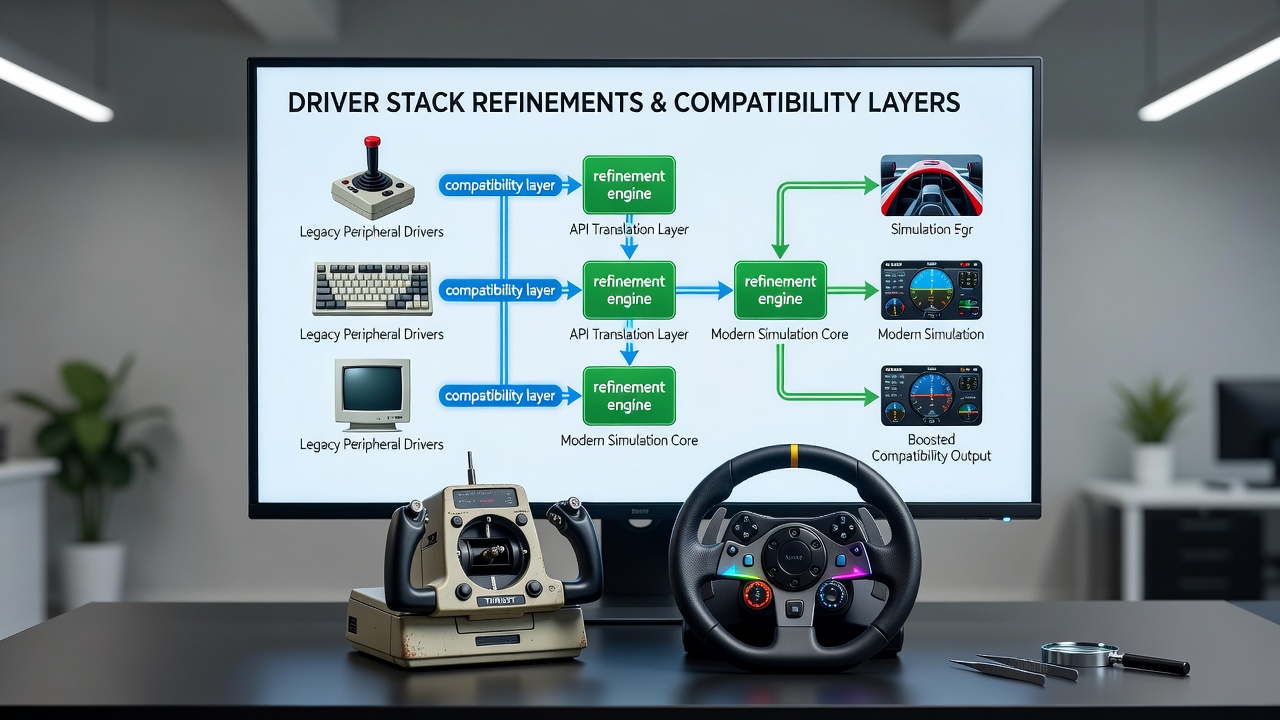
Case examples include regional esports circuits in Germany that transitioned entire fleets of aging wheel bases to updated driver stacks without hardware replacement. Figures from those events reveal consistent lap-time variance reductions of 3 to 5 percent after the August 2026 patches, attributed to restored force-feedback fidelity rather than changes in participant skill levels. European Simulation Technology Association documentation further details how modular driver components allow selective loading of legacy emulation modules only when specific device signatures appear during boot, minimizing overhead on systems running multiple concurrent simulation instances.
Integration Challenges and Resolution Patterns
Integration of refined stacks sometimes encounters edge cases involving power delivery negotiation on USB hubs shared between multiple legacy devices. Technicians address these through firmware-level current limiting adjustments that prevent brownouts during simultaneous force-feedback activation, a pattern documented in field reports submitted to the PCI Special Interest Group standards body. Those reports also note that users who combine older peripherals with modern direct-drive bases now experience fewer conflicts when running mixed USB 2.0 and 3.2 topologies, since the updated compatibility layers enforce explicit bandwidth reservation during device initialization.
Conclusion
Driver stack refinements continue to extend the operational lifespan of established peripherals within evolving simulation ecosystems. Evidence from multiple regions shows measurable improvements in input reliability and calibration accuracy following the August 2026 update cycle, supporting continued deployment of legacy hardware alongside newer simulation platforms without mandatory upgrades.