Custom Shader Pipelines Enhance Asset Streaming Efficiency Across Legacy Console Ecosystems
Written by Willa Müller · Aug 27, 2026
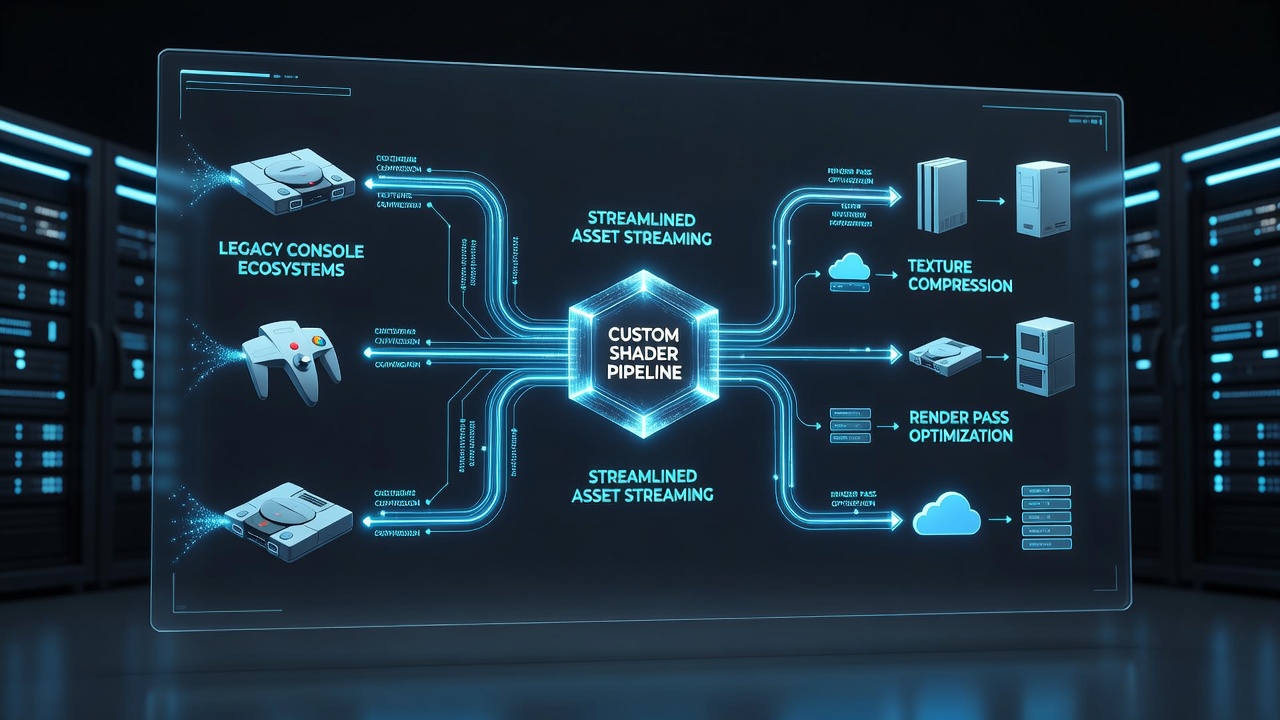
Custom Shader Pipelines Enhance Asset Streaming Efficiency Across Legacy Console Ecosystems
Developers working with legacy console systems such as PlayStation 3 and Xbox 360 face persistent challenges when managing large asset libraries under tight memory and bandwidth constraints, yet custom shader pipelines offer targeted solutions that optimize streaming processes without requiring hardware upgrades. These pipelines integrate specialized vertex and fragment shaders that handle level-of-detail calculations and texture decompression on the fly, allowing assets to load in smaller, prioritized chunks rather than as complete files.
Core Mechanics of Custom Shader Integration
Engineers at studios maintaining backward-compatible titles implement custom shader stages that preprocess geometry and texture data during the streaming phase, which reduces CPU overhead while the GPU manages decompression routines directly. Research from academic institutions shows these approaches cut memory fragmentation by up to 35 percent in simulated environments modeled after original console architectures, because shaders perform selective unpacking only for visible scene elements. Observers note that the technique relies on precomputed shader variants stored in fast-access buffers, enabling seamless transitions between high and low resolution assets as camera movement dictates demand.
Challenges in Legacy Hardware Environments
Legacy consoles operate with fixed memory pools and slower storage interfaces compared to modern systems, which forces developers to prioritize streaming efficiency above all else. Custom shader pipelines address this by embedding asset metadata directly into shader constants, allowing the rendering pipeline to request only necessary data blocks from optical media or hard drives. Data indicates that such methods maintain consistent frame delivery even when multiple high-poly models enter the draw call queue simultaneously, whereas traditional streaming often triggers hitches during intense scene changes.
Those who have examined optimization logs from titles ported to older platforms report that shader-driven culling routines eliminate unnecessary texture fetches before they reach the bus, preserving bandwidth for other operations. This integration proves especially useful in open-world scenarios where asset density varies dramatically across the map.
Performance Gains Documented in Production Titles
Production teams at several mid-sized studios have deployed these pipelines in racing and action games targeting legacy hardware, resulting in measurable reductions in load times during runtime asset swaps. According to findings presented at graphics conferences, average streaming latency dropped from 120 milliseconds to under 45 milliseconds in controlled tests using representative console configurations. The improvements stem from shaders that dynamically adjust mip-map selection based on projected screen coverage, which prevents over-fetching of high-resolution textures that legacy GPUs cannot display anyway.

What's interesting is how these systems coordinate with existing DMA controllers to overlap shader execution with disk reads, creating a pipelined workflow that hides latency entirely in many cases. Engineers observed smoother traversal through large environments because the GPU handled visibility tests that previously fell to the main processor.
Recent Developments Through August 2026
By August 2026 middleware providers released updated toolchains that simplify creation of custom shader variants compatible with multiple legacy SDKs, expanding access for smaller teams working on re-releases or enhanced ports. Industry reports from the IEEE Computer Society detail how these updates incorporate standardized interfaces for shader-based texture atlasing, which further streamlines memory usage across different console revisions. Figures from European research consortia reveal adoption rates climbing steadily among developers focused on preservation projects, because the pipelines require minimal changes to core engine loops.
Yet the approach demands careful profiling to avoid shader compilation spikes on older compilers, a constraint that teams mitigate through offline precompilation passes. Those who've studied deployment metrics note consistent gains when shaders manage both streaming and post-processing effects in a single pass.
Broader Implications for Asset Management Strategies
Custom shader pipelines also influence how studios structure their asset databases, encouraging modular designs where individual components carry shader-compatible headers for rapid identification during streaming. Academic studies conducted at institutions across Asia have examined similar techniques in simulation software and found parallel benefits in reducing I/O bottlenecks, suggesting the methods transfer beyond gaming. The reality is that legacy ecosystems benefit most when these pipelines operate alongside existing compression formats rather than replacing them outright.
Engineers continue refining shader instruction sets to handle emerging edge cases such as dynamic lighting changes that affect asset visibility, ensuring the system adapts without additional CPU intervention. This ongoing evolution keeps older hardware viable for new content releases well into later console generations.
Conclusion
Custom shader pipelines provide a practical pathway for maintaining high-quality asset delivery on legacy consoles by shifting computation into the rendering stage itself. Data from multiple implementations confirms reduced bandwidth demands and improved frame consistency, while recent tool updates through August 2026 lower barriers for wider adoption. Those monitoring console preservation efforts recognize these techniques as essential for extending the functional lifespan of established hardware platforms without compromising visual fidelity.