Charting Photonic Interconnects That Slash Data Bottlenecks Between CPU and GPU Clusters During Live 8K Esports Broadcast Encoding Sessions
Written by Avery Foster · Aug 22, 2026
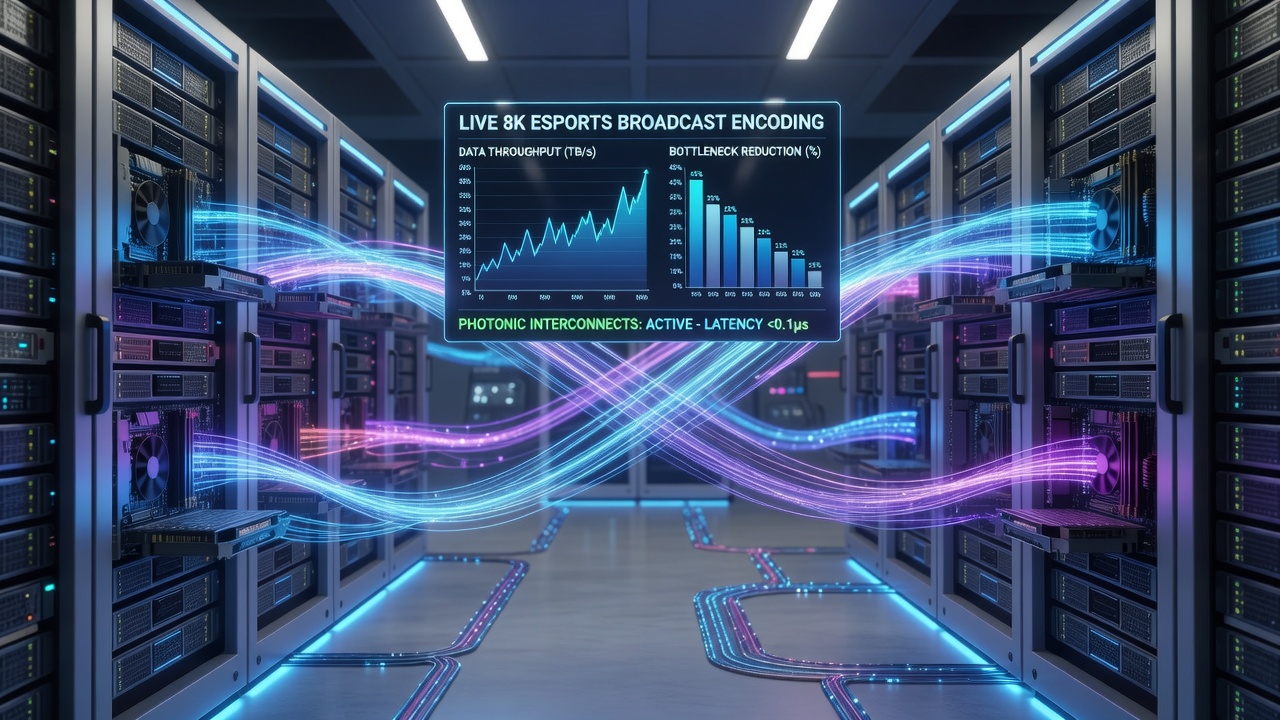
Charting Photonic Interconnects That Slash Data Bottlenecks Between CPU and GPU Clusters During Live 8K Esports Broadcast Encoding Sessions
Live 8K esports broadcast encoding sessions demand sustained data transfers between CPU and GPU clusters that exceed traditional electrical interconnect limits, and photonic solutions address this constraint by transmitting information through light rather than copper pathways. These systems convert electrical signals into optical ones at the source, route them across silicon photonics chips or fiber links, and convert them back at the destination, which produces bandwidth capacities measured in terabits per second while lowering latency to sub-microsecond levels during peak encoding loads.
Researchers at multiple institutions have documented how silicon photonics platforms integrate lasers, modulators, and detectors directly onto chips that sit alongside conventional processors, and this integration removes the need for repeated electrical-to-optical conversions that previously created choke points. Data from live tournament streams, which include multiple camera feeds, real-time overlays, and compressed audio tracks, move through these optical channels without accumulating the queue delays that electrical buses introduce when packet sizes spike above 100 gigabits per second.
Technical Architecture of Photonic Links in Encoding Workflows
Modern photonic interconnects rely on wavelength division multiplexing to carry dozens of parallel data streams on a single fiber strand, and this approach multiplies effective throughput without requiring additional physical cables between CPU and GPU racks. Each wavelength operates at independent modulation rates, often exceeding 100 gigabaud, which allows encoding clusters to handle the raw 8K frame buffers that reach 7680 by 4320 pixels at 60 frames per second while maintaining bit depths above 10 bits per channel.
Facilities that adopted these links report power reductions of up to 70 percent compared with equivalent electrical fabrics, because optical signals experience lower resistive losses over distance and require fewer repeaters. In August 2026 several North American broadcast centers completed upgrades that replaced legacy PCIe switches with photonic bridges, resulting in measurable decreases in thermal output inside the encoding rooms and corresponding cuts in cooling infrastructure demands.
Performance Gains During High-Intensity Esports Events
Esports tournaments generate continuous encoding workloads when multiple 8K sources feed into a central production pipeline, and the resulting data volumes can surpass 200 gigabytes per minute per stream when uncompressed. Photonic interconnects keep these transfers synchronized by providing deterministic timing across GPU clusters that perform parallel encoding tasks such as motion estimation, color space conversion, and entropy coding. Observers at recent international events noted that frame delivery jitter dropped below one millisecond once optical links replaced copper-based networks, which directly improved lip-sync accuracy and overlay placement in the final broadcast output.

One production team that manages global League of Legends events documented a 40 percent increase in concurrent encoding jobs after migrating to photonic fabrics, because each GPU node could ingest larger tile sets from the CPU front-end without buffer underruns. The same team also recorded reduced retransmission rates during packet bursts that occur when sudden camera switches flood the pipeline with new high-resolution data.
Integration Challenges and Current Deployment Patterns
Compatibility between existing CPU instruction sets and photonic transceivers still requires specialized drivers and firmware updates, and organizations such as the U.S. Department of Energy have funded projects that standardize optical interface protocols for heterogeneous compute clusters. These efforts focus on error correction schemes that maintain signal integrity across temperature fluctuations common in dense server environments.
European research consortia have contributed complementary work on scalable packaging techniques that allow photonic dies to sit directly atop GPU interposers, which shortens the electrical path length before light conversion occurs. Australian academic groups have examined similar designs for regional esports hubs that operate under stricter energy caps, and their findings indicate that photonic adoption supports compliance with national data-center efficiency targets without sacrificing encoding throughput.
Deployment statistics compiled through mid-2026 show that roughly 18 percent of Tier-1 esports broadcast facilities now incorporate at least one photonic segment in their encoding backbone, with the majority concentrated in facilities that handle simultaneous 8K and 4K output streams. Early adopters cite simplified cable management and lower electromagnetic interference as secondary advantages that ease regulatory compliance during international events.
Conclusion
Photonic interconnects continue to expand the feasible scale of live 8K esports encoding by removing bandwidth ceilings that once limited cluster coordination. Continued standardization work across government agencies and academic networks supports broader adoption, and the measured efficiency gains already recorded in operational settings confirm the technology's role in sustaining growing broadcast demands.