25 Jun 2026
Cache Hierarchy Optimizations Reducing Frame Stutters During Complex Scene Transitions in Simulation Titles
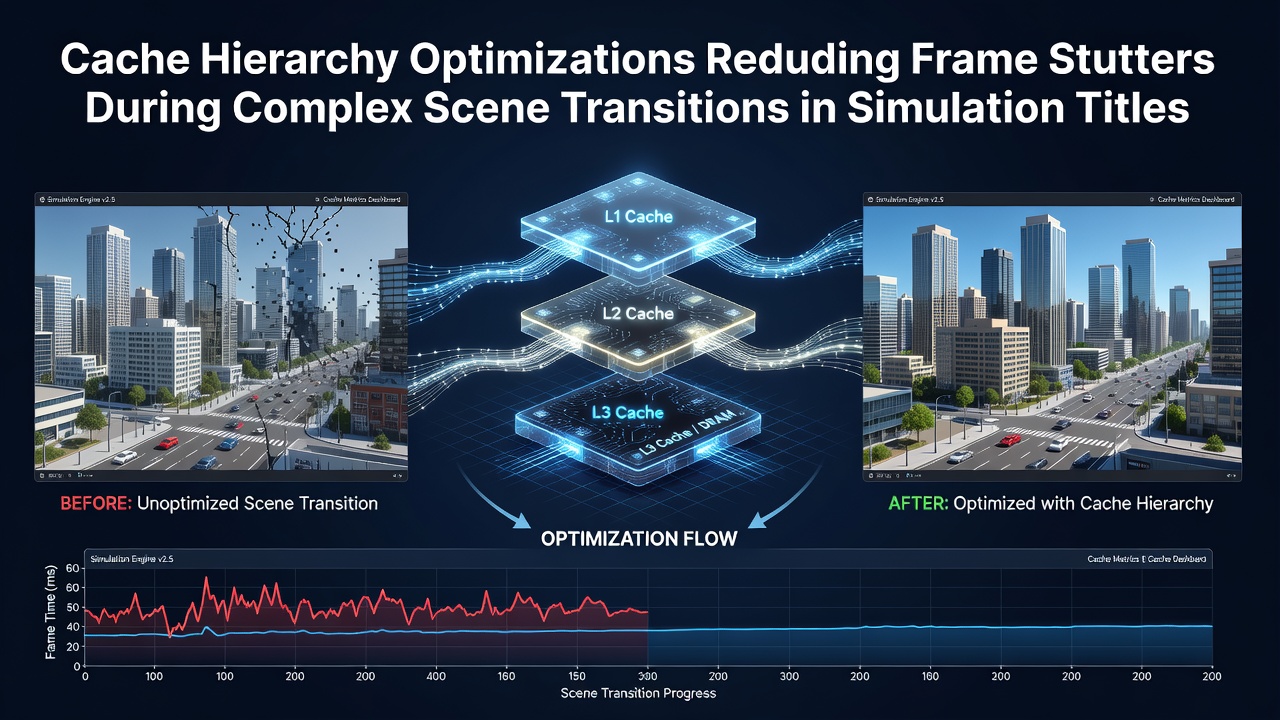
Modern simulation titles demand rapid data access during complex scene transitions where multiple assets load simultaneously, and cache hierarchy optimizations address these demands by improving data locality and reducing memory latency bottlenecks that cause frame stutters. Processors incorporate layered caches with L1 offering minimal latency at limited capacity, L2 balancing speed and size, plus L3 providing shared resources across cores, and developers tune software to exploit these layers effectively in engines handling large-scale environments.
Core Mechanics of Cache Hierarchies in Gaming Hardware
Simulation games process vast datasets including terrain models, vehicle physics, and AI behaviors that shift abruptly during transitions, so cache systems prefetch relevant data blocks ahead of CPU requests while minimizing evictions of frequently used information. Data shows that optimized prefetchers in recent CPU architectures detect sequential access patterns common in scene loading routines, and they pull additional cache lines into faster tiers before stalls occur. Researchers at institutions across North America and Europe have documented how aligning data structures to cache line boundaries cuts compulsory misses during these high-load moments, which maintains consistent frame delivery without relying solely on faster main memory subsystems.
Hardware vendors release microcode updates that refine replacement policies in L3 caches, allowing simulation titles to retain critical rendering buffers longer while less urgent data moves out, and this approach proves particularly effective in titles featuring dynamic weather systems or large crowds that trigger frequent asset swaps. Observers note measurable drops in frame time variance when these policies prioritize write-back operations for modified simulation states, preventing the spikes that interrupt immersion during viewpoint changes.
Software Techniques Targeting Scene Transition Performance
Engine programmers implement cache-aware algorithms that reorder computation tasks to maximize temporal and spatial locality, such as batching particle system updates with nearby geometry fetches so that data remains resident across multiple frames. Studies indicate these reorderings reduce conflict misses in set-associative caches when multiple threads compete for the same cache sets during intense transition sequences. One approach involves partitioning simulation workloads across cores with affinity settings that keep related data within shared L3 slices, thereby lowering inter-core communication overheads that otherwise manifest as stuttering.
According to findings presented through IEEE technical publications, explicit cache control instructions allow developers to hint which buffers should stay pinned during loading phases, and titles incorporating these hints exhibit smoother frame pacing in benchmarks run on both Intel and AMD platforms. The techniques extend to GPU-side caches as well, where texture streaming pipelines benefit from similar locality enhancements that prevent shader stalls when new environment maps activate mid-transition.
Performance Data from Recent Implementations
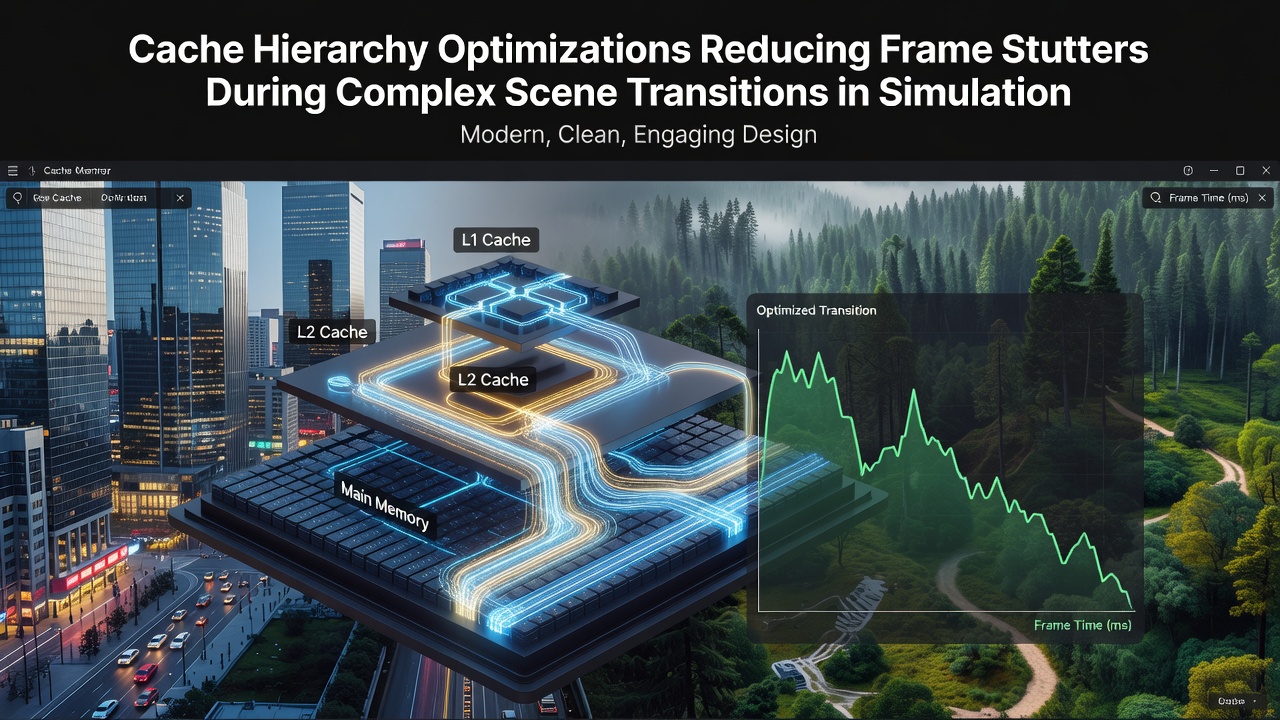
Benchmarks conducted in early 2026 reveal that titles updated with refined cache partitioning show average frame time reductions of up to 18 percent during targeted transition sequences compared with unoptimized versions. Figures from collaborative tests involving hardware partners in the Asia-Pacific region demonstrate consistent gains across varied system configurations, including those with mixed DDR5 memory kits. These improvements stem from fewer last-level cache misses rather than raw clock speed increases, highlighting the value of software-hardware co-design in simulation workloads.
Additional analysis from research groups at the Australian National University highlights how machine learning models trained on access traces can predict optimal cache insertion points for specific transition types, allowing runtime adjustments without manual tuning per scene. The models integrate into existing profiling tools and deliver results that generalize across different simulation genres, from flight models to urban planning environments.
Integration with Emerging Hardware Features in June 2026
June 2026 brings wider availability of processors featuring enhanced cache coherence protocols that accelerate data sharing between CPU and integrated graphics during mixed workloads, and simulation developers already leverage these protocols to synchronize asset streams more efficiently. Industry reports from trade associations confirm that coherence traffic drops measurably when titles align their memory allocators with the new hardware behaviors, which translates directly to fewer dropped frames at critical moments. Partnerships between engine teams and chip designers continue to explore dynamic cache resizing that adapts to workload intensity detected through performance counters embedded in the silicon.
Those tracking hardware roadmaps observe that upcoming memory controllers incorporate smarter prefetch throttling tuned specifically for bursty access patterns found in simulation transitions, reducing unnecessary bandwidth consumption while preserving responsiveness. The changes complement existing optimizations without requiring extensive code rewrites, enabling broader adoption across independent studios and larger publishers alike.
Conclusion
Cache hierarchy optimizations continue to deliver tangible benefits for frame stability in simulation titles by targeting the root causes of stutters at the data movement level. Evidence from multiple research efforts and hardware iterations shows sustained progress through combined software and architectural refinements, and ongoing work promises further gains as simulation complexity increases. Developers gain practical tools that maintain performance across diverse hardware while preserving the detailed experiences players expect during demanding scene changes.