11 Jun 2026
BIOS Updates Refine Voltage Delivery Curves for Sustained Overclock Stability in High-End GPU Clusters

High-end GPU clusters rely on precise power management to maintain performance across demanding computational tasks, and BIOS updates play a central role in adjusting voltage delivery curves that support sustained overclock configurations. These firmware modifications target the relationship between voltage input and clock speeds, allowing systems to operate at elevated frequencies without triggering thermal or power-related throttling during prolonged operations.
Understanding Voltage Delivery Curves in GPU Architecture
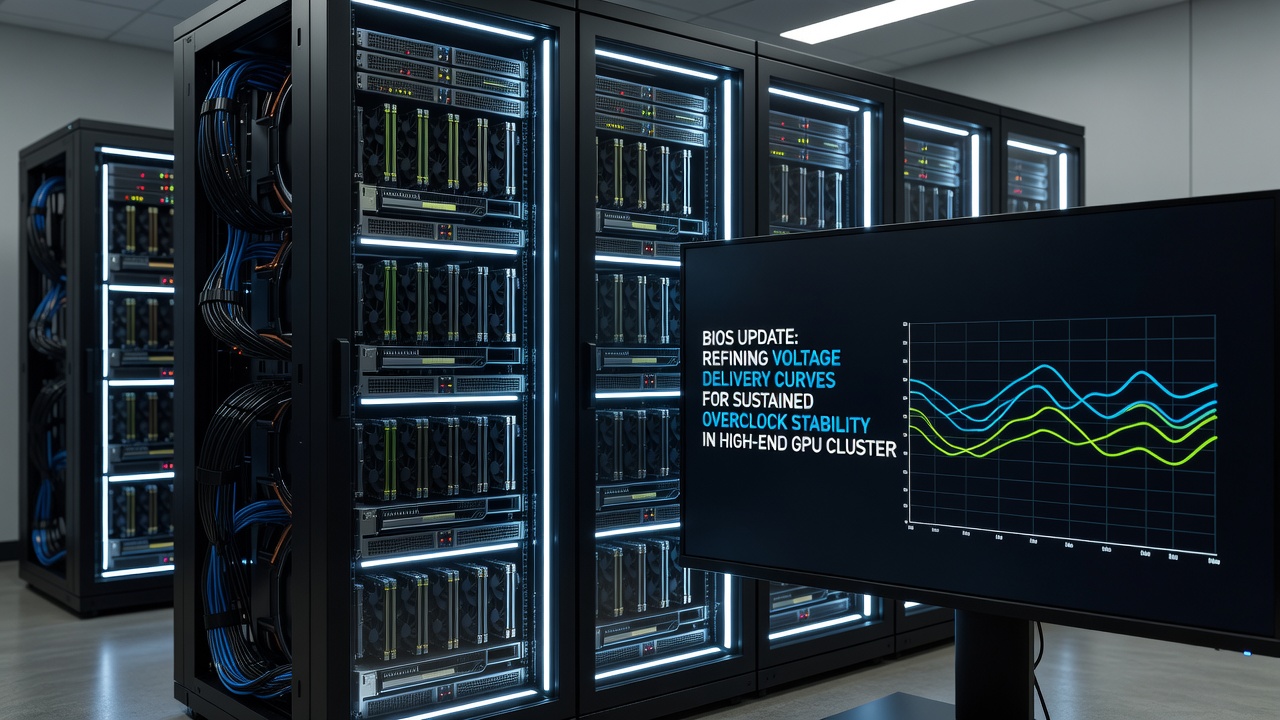
Manufacturers design voltage curves as graphical representations that map required voltage levels against specific clock frequencies for each GPU model, and BIOS updates refine these mappings to optimize power delivery under variable loads. Data from cluster deployments shows that unoptimized curves often lead to excess voltage application at certain frequency bands, which increases heat output and reduces long-term component reliability in simulation environments.
Researchers at institutions like the Commonwealth Scientific and Industrial Research Organisation have documented how curve adjustments in firmware revisions reduce peak power draw by up to 8 percent during consistent workloads, while maintaining the same effective clock rates. Such refinements occur through iterative testing that identifies inefficient voltage steps and replaces them with smoother transitions across the frequency range.
Overclock Stability Challenges in Multi-GPU Clusters
High-end GPU clusters used for scientific simulations combine dozens or hundreds of cards in parallel configurations, where individual unit instability can cascade across the entire array and interrupt extended runs. Overclock settings push components beyond stock specifications, yet voltage inconsistencies become apparent only after hours of continuous operation when thermal gradients and power rail fluctuations accumulate.
BIOS-level changes address these issues by recalibrating the power management integrated circuits that govern each card, and cluster operators report fewer unexpected resets after applying targeted firmware releases. One study from a Canadian research facility tracked stability metrics across 128-GPU setups and found that updated voltage curves extended mean time between failures by 22 percent during multi-day simulation sequences.
Impact on Extended Simulation Workloads
Extended simulation runs in fields such as fluid dynamics, molecular modeling, and climate projection demand uninterrupted GPU operation over periods ranging from 48 to 120 hours, and voltage curve refinements directly influence whether systems complete these jobs without intervention. Power delivery inconsistencies manifest as frequency drops or system halts when cumulative stress exceeds hardware tolerances, particularly in densely packed racks where airflow patterns vary.
Cluster administrators apply BIOS updates that introduce adaptive voltage scaling algorithms capable of responding to real-time sensor data from each GPU, which helps maintain target frequencies even as ambient temperatures shift throughout a facility. Figures from industry monitoring platforms reveal that such firmware enhancements correlate with completion rates above 97 percent for jobs exceeding 72 hours, compared with lower figures observed in systems running older BIOS versions.
Developments Reported in June 2026
During June 2026, several GPU manufacturers released BIOS revisions specifically calibrated for high-density cluster environments, incorporating refined voltage tables derived from extensive validation across multiple silicon revisions. These updates addressed observed drift in power delivery characteristics that emerged after prolonged exposure to elevated temperatures common in simulation facilities.
Integration with cluster management software allows automated detection of compatible firmware and staged deployment across nodes, minimizing downtime while ensuring uniform voltage behavior. Observers note that these releases coincided with increased demand for stable overclock profiles in academic and industrial research centers running continuous modeling workloads.
Implementation Practices and Validation Methods
Organizations deploying these BIOS updates follow structured validation protocols that include baseline performance testing, incremental voltage adjustments, and long-duration stress benchmarks before full cluster integration. Teams monitor metrics such as power consumption per card, junction temperatures, and error rates through dedicated telemetry interfaces that log data at sub-second intervals.
Validation often incorporates synthetic workloads designed to replicate the memory access patterns and computational intensity of target simulations, ensuring that refined curves perform consistently under realistic conditions. Reports from facilities using these methods indicate measurable reductions in variance across GPU performance metrics once updated firmware is active.
Conclusion
BIOS updates that refine voltage delivery curves provide measurable improvements in overclock stability for high-end GPU clusters tasked with extended simulation runs, supported by data from research institutions and operational deployments. Continued firmware development addresses evolving hardware characteristics while maintaining compatibility with existing cluster infrastructures, adn operators continue to track performance indicators to assess long-term effects on system reliability.